
Slab Leak Detection & Repair in Payson, AZ
A water bill that jumps for no reason, a warm patch on the floor, the sound of running water when every tap is off. A slab leak doesn’t announce itself — it shows up in what it does to your home. We find it first, then talk repair. In that order, every time.
A slab leak is a water line leaking underneath the concrete slab your home sits on. You usually can’t see the leak itself — you see what it does: a water bill that jumps for no reason, a warm patch on the floor, a damp spot that won’t dry, or the sound of running water when every tap is off. We find slab leaks in Payson homes without tearing up floors to go looking for them. Pressure testing, acoustic listening, and thermal imaging narrow the leak down to a point first. Then you get your repair options in writing — spot repair, reroute, or repipe — before any concrete is cut. We serve Payson, Pine, Strawberry, and the Rim Country, with emergency plumbers available 24/7. Call (928) 260-9425.
In This Guide
- What a Slab Leak Actually Is
- Why Payson Homes Get Them
- Eight Warning Signs of a Slab Leak
- What to Do Right Now
- How Detection Works
- Repair Options Compared
- What Slab Leak Repair Costs in Payson, AZ
- Insurance and Documentation
- Repair It, or Repipe the House?
- Cabin and Seasonal Homes
- How It Works
- Frequently Asked Questions
What a Slab Leak Actually Is
Most Arizona homes sit on a single concrete slab poured right on the ground, and the water lines run underneath it, inside the concrete or in the soil below. That’s standard construction here, and it works fine — until a line starts leaking under there.
The tricky part is that the water doesn’t come straight up. It travels under the slab, along the easiest path, and shows up somewhere else entirely: a damp spot in the hallway when the leak is under the bathroom, a warm patch in the living room when the leak is under the kitchen. That’s why chasing the visible symptom usually means opening the wrong piece of floor.
There are two kinds of under-slab lines, and it matters which one is leaking:
🚿 Supply lines
Supply lines carry pressurized water to your taps. A leak here runs constantly, 24 hours a day, and it’s the one that spikes your water bill and erodes soil under the slab.
🕐 Drain lines
Drain lines carry wastewater away by gravity. A leak here shows up more slowly — dampness, smell, soggy spots — and it’s found with a camera, not with listening equipment.
A meter test tells you which side you’re on before anyone picks up a tool. More on that below.
Why Payson Homes Get Them
Payson isn’t Phoenix, and its slab leaks don’t come from one single cause. They come from a combination this town is particularly good at producing:
- Age. A large share of Payson homes were built in the 1970s through the 1990s, and many still have their original copper lines under the slab. Copper is a good pipe, but after 25-plus years in concrete, pinhole corrosion starts showing up — tiny pits that eat through the wall of the pipe from the inside out. One pinhole is a repair. Three pinholes in five years is a pattern, and it changes the whole conversation.
- Hard water. Payson town water runs 140-300 ppm hardness depending on the well and the season — that’s moderately hard to very hard water. Hard water leaves mineral scale inside pipes, and scale plus age is what turns a healthy copper line into a pitted one. It’s also why water heaters here last 8–10 years instead of the 12–15 you’d see with soft water. A softener won’t fix a leak that’s already there, but after a slab repair it’s the single best thing you can do to slow the next one down. Our hard water guide explains what Payson water does to plumbing, and what actually helps.
- Soil that moves. Monsoon season soaks the ground, then it dries out again, and that wet-dry cycle shifts the soil under a slab. Rigid copper inside concrete doesn’t flex with it — it rubs, it stresses, and eventually it cracks, usually right where the pipe passes through the concrete.
- Freeze-thaw. Payson sits around 5,000 feet, and winter nights regularly drop into the teens and twenties from November through March. Water lines in a slab aren’t as exposed as an outdoor hose bibb, but the ground around a foundation still freezes and thaws, and that movement works on joints and older lines all winter.
- Pressure. High water pressure wears pipes from the inside. If your home has no pressure regulator, or the one you have failed years ago, every line in the house — including the ones under the slab — is living a harder life than it should.
None of this means your house is doomed. It means a Payson home with original under-slab plumbing deserves a different level of attention than a five-year-old house in a new subdivision — and a leak that gets found early costs a fraction of one that runs for months.
Eight Warning Signs of a Slab Leak
Slab leaks almost always announce themselves before the damage gets severe — if you know what to listen and look for. Here are the eight warning signs:
1. You hear running water when everything is off
Stand in a quiet hallway or bedroom and listen — if you hear a faint, constant hiss or trickle, a supply line under your slab has almost certainly sprung a leak. It is easiest to hear late at night or early in the morning, when the house is silent.
2. Your water bill jumped for no clear reason
A slab leak can waste thousands of gallons a month. Pull out your last few bills and compare them against the same months last year — if your usage climbed sharply and your household habits have not changed, a hidden leak is a likely culprit.
3. A warm spot on the floor
Walk barefoot across tile or hard flooring in the morning — a patch that is noticeably warmer than the floor around it suggests a hot-water line leaking underneath. Carpet can mask this, so pay attention to rooms with hard-surface flooring.
4. Damp spots, staining, or warping on floors
Watch for dark stains along grout lines or baseboards, damp carpet that never fully dries, or laminate and wood flooring that bubbles, warps, or separates. In Payson’s dry climate, a mysteriously damp floor is never “just humidity.”
5. Cracks in walls, floors, or the foundation
Look for new diagonal cracks in drywall (especially around doors and windows), cracks in tile flooring, or widening gaps in existing hairline foundation cracks. A crack that suddenly grows is more alarming than one that has been stable for years.
6. A musty or mildew smell that won’t go away
Slab moisture wicks upward into the bottom plates of framed walls, carpet padding, and baseboards. Once that material stays damp, mold and mildew follow — and you’ll smell it before you see it. If a particular room or hallway smells musty even after cleaning, hidden moisture under the slab could be feeding it.
7. Your water pressure dropped throughout the house
If you have noticed weaker flow at your faucets and showerheads across the whole house — not just one fixture — a supply-line leak may be diverting water before it ever reaches your taps. (If it is only one faucet, check for a clogged aerator first.) Whole-house pressure loss paired with any of the signs above points strongly toward a supply-line leak.
8. Your water meter spins with everything turned off
Find your water meter (usually near the curb or in a meter box), make sure every fixture and appliance is off, then watch the meter’s dial or leak indicator. If it is still moving, water is flowing somewhere — and you have a confirmed leak in your supply system. At that point, calling a plumber is the next step, not a question. The full two-minute version, with the shutoff steps, is in the What to Do Right Now section below.
If two or more of these eight signs sound familiar, treat it as a slab leak until a professional proves otherwise.
What happens if you ignore it
An unchecked slab leak erodes the soil supporting your foundation, feeds mold inside wall cavities, and ruins flooring far beyond the leak’s location. It also wastes enormous amounts of water. Small, catchable leaks can turn into multi-room flooring replacements and mold remediation if the early signs are dismissed for months — early detection is the difference between a manageable repair and a major restoration.
What to Do Right Now
If you suspect a slab leak, don’t wait for it to get worse, and don’t let anyone start jackhammering before the leak is located. Here’s the sequence:
- Run the meter test (two minutes, no tools)
Turn off every tap, appliance, and irrigation valve in the house. Go to the water meter — usually near the curb in a ground-level box — and watch the dial or the small leak indicator triangle. If everything is off and that dial is still moving, water is going somewhere it shouldn’t be. That’s a confirmed supply-side leak, and it’s the single most useful thing you can tell a plumber when you call.
- If water is flooding or the meter is spinning fast, shut off the main
The main shutoff is usually where the water line enters the house, or at the meter itself. Know where yours is before you need it — in an emergency, that’s the difference between a wet floor and a flooded house.
- Call for detection, not for demolition
The most expensive mistake in slab leak work is opening concrete before the leak is pinpointed. Detection comes first, repair options second, concrete third — in that order, every time.
- Take photos of everything you can see
Damp spots, warped flooring, cracks, the meter reading, the water bill. If insurance gets involved later, photos taken before any work starts are worth more than photos taken after.
The eight warning signs are covered in detail in the Eight Warning Signs of a Slab Leak section above. Once you have spotted one or more of them, the leak is suspected. Here is what happens next.
How Detection Works (the Visit, Step by Step)
A slab leak detection visit isn’t one tool and a guess. It’s a sequence, and each step narrows the search:
1. Confirm and isolate
We start with the meter test and then pressure-test the system, isolating sections of pipe one at a time. If the pressure holds on the cold side but drops on the hot side, we’ve just cut the search area in half without touching a single tile. Pressure testing confirms a leak exists and which line it’s on — it doesn’t pinpoint the spot by itself.
2. Listen
Acoustic listening equipment — sensitive ground microphones — picks up the sound of pressurized water escaping through concrete. A supply leak under a slab has a distinct sound signature, and an experienced ear can follow it to within a few feet. This is the workhorse method for pressurized lines, and it’s strongest exactly where the leak is hardest to see.
3. See the heat
A thermal imaging camera maps temperature differences across the floor. A hot-water line leak warms the slab above it, and that warm patch shows up on camera even when the floor feels normal to your hand. Thermal is strongest on hot lines; on a cold line it’s one clue among several, not the whole answer.
4. Mark it and document it
Once the methods agree on a location, the spot gets marked and you get a written report: what was found, where it is, photos, and your repair options. That report matters beyond the repair itself — it’s what your insurer asks for, and it’s what a future buyer asks for too.
The whole detection visit usually takes a few hours, not a few days. And here’s the honest part: no single tool does it all. Pressure testing confirms, acoustic listening locates, thermal imaging corroborates. A company that shows up with one gadget and starts cutting is guessing with your floor.
Detection on our leak detection page covers the same approach in general — slab work is where it matters most, because the cost of being wrong is a hole in the wrong place.
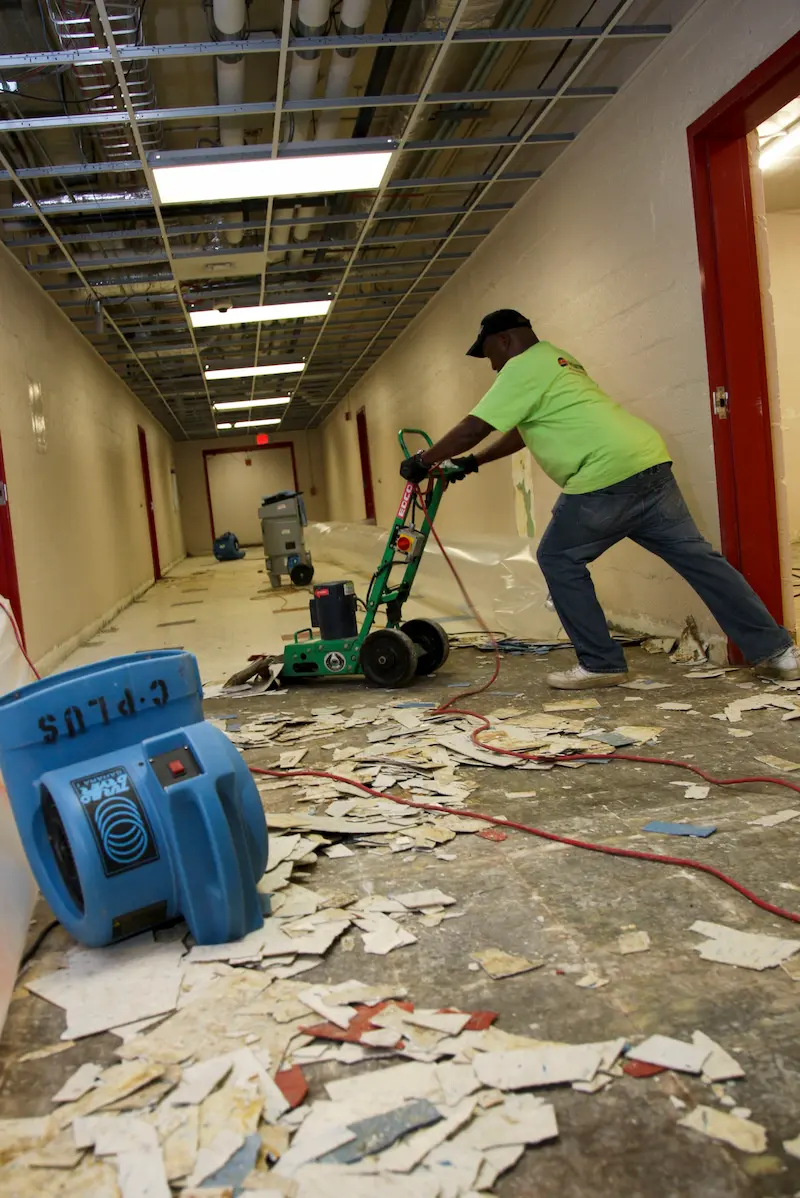
Found First, Then Fixed
Opening a floor to the slab is disruptive, dusty work — which is exactly why it comes last. Detection first means one opening in the right place, not several in the wrong ones.
- ✔ Leak located before any concrete is cut
- ✔ Repair options priced in writing first
- ✔ Written report with photos for your insurer
Repair Options Compared
Once the leak is located, there are four real options. Which one fits depends on the age of your system, how many leaks you’ve had, where the leak sits, and what your floor is made of.
| Option | What happens | Best when | Disruption |
|---|---|---|---|
| Spot repair | A small opening is cut in the slab directly above the leak, the damaged section is replaced, and the concrete is repoured. | One isolated leak in an otherwise healthy, newer system. | Highest at the spot itself — jackhammer noise and dust, and that section of flooring needs restoration. Usually done in a day. |
| Reroute | The under-slab line is abandoned and a new line (usually PEX) is run through the attic or walls instead. | The leak is hard to reach, you’ve had leaks before, or the line itself is failing. Rerouting ends slab leaks on that line permanently. | Drywall openings rather than floor demolition; typically 1–3 days. |
| Tunneling | The ground outside the foundation is excavated and a tunnel is dug horizontally beneath the slab to reach the leak, so a longer section can be replaced. | The leak sits under something permanent — a bathtub, a kitchen island — or the interior flooring must be preserved at all costs. | No interior demolition, but labor-intensive, needs suitable soil, and the backfill has to be compacted properly to keep supporting the foundation. Typically 2–4 days. |
| Repipe | The home’s supply lines are replaced (usually in PEX), bypassing the under-slab system entirely. | Multiple leaks, system-wide corrosion, or galvanized lines that are failing everywhere at once. | Drywall work throughout the house rather than slab work; typically 2–4 days, and it’s the last slab leak repair you’ll ever need on those lines. |
Two things that are NOT options for a pressurized supply leak under a slab, no matter what a website promises: epoxy lining and “injection” sealing. Lining works inside drain and sewer lines, where water flows by gravity. A supply line runs under pressure, and no coating reliably seals a pinhole that’s being pushed open 24 hours a day. If someone offers you a no-dig miracle fix for a supply-side slab leak, get a second opinion before you pay for it.
Every option above gets priced in writing before work starts, and the price covers the plumbing work. Flooring restoration and concrete finishing after a spot repair are priced separately — that’s build-back work, and any honest quote says so up front instead of burying it.
Our pipe repair page covers repiping in detail, including the PEX-versus-copper question, if you’re weighing a full repipe against another spot fix.
What Slab Leak Repair Costs in Payson, AZ
Straight numbers, with sources labeled honestly:
- Detection: $150–$350. That’s our own Payson range for leak detection in Payson, depending on the method and the area involved. It’s the only Payson-specific figure on this page.
- Repair: national benchmarks, not a Payson quote. Angi’s 2026 national figures put a typical slab leak repair at $630–$4,400, averaging around $2,280, with detection included. A single pinhole fix runs $150–$800 nationally; a reroute $600–$4,000. Those are national figures, not a Payson quote — they’re here so you can judge whether a quote is in a sane ballpark, not as a promise. Call for a location-specific estimate: your written quote after detection is the number that counts, and it depends on the method, the location, and what your floor is made of.
- What’s separate: permits where required, and flooring/concrete restoration after a spot repair. Both get listed on your quote, not discovered after the fact.
- What we don’t do: we don’t quote a repair price over the phone for a leak nobody has located yet. Anyone who does is guessing, and you’ll pay for the guess one way or another.
For the full local pricing picture — service calls, hourly ranges, emergency multipliers — our Payson plumber cost guide has the breakdown.
Call (928) 260-9425
Insurance and Documentation
This is where most homeowners lose money they didn’t have to lose, so here’s the pattern straight:
Most standard homeowners policies cover the water damage a sudden, accidental leak causes — ruined flooring, wet drywall, damaged contents — and often the access cost of reaching the leak, meaning the jackhammering and opening up. What they usually do not cover is the pipe repair itself, because a corroded pipe is wear and tear, not an accident. And a leak that ran for months unaddressed gets treated very differently from one that was found and reported promptly. Gradual damage is the exclusion insurers reach for first.
That’s why documentation matters more than most people realize:
- Get the detection report and photos before demolition starts
Findings, leak location, photos, repair options — in writing.
- Call your insurer promptly, and ask three specific questions
Is a sudden rupture covered differently from a long-term seep? Are access and tear-out costs covered? What’s my deductible versus the repair cost?
- Keep every invoice
Detection, repair, restoration — all of it, filed together.
Policies vary, and yours is the only one that counts — check it before repairs begin, not after. But the homeowners who get paid are almost always the ones who can show when the leak was found, where it was, and what was done about it, in that order.
Repair It, or Repipe the House?
This is the question that actually decides whether you spend money once or keep spending it:
- One leak, newer system, good water pressure everywhere else? Spot repair. Fix it, restore the floor, move on.
- Second or third leak, or leaks in different rooms? The system is telling you something. Every patch leaves the rest of the aging line in place, and the next pinhole is a matter of time, not chance. At that point a reroute of the failing line — or a full repipe if the corrosion is system-wide — costs less over five years than three separate slab openings.
- Galvanized lines? Different conversation. Galvanized steel corrodes from the inside, narrows as it goes, and fails in sections. A spot repair on a galvanized system is a bandage on a line that’s failing everywhere.
A good rule of thumb from plumbers who do this every week: the third pinhole in five years means stop patching. That’s not a sales line — it’s arithmetic. Three slab openings cost more, in money and in flooring, than one reroute.
Cabin and Seasonal Homes
Payson has a housing type most valley cities don’t: the cabin that sits empty for months. Pine, Strawberry, and the Rim Country are full of seasonal homes, and a slab leak in an empty house is the worst version of this problem — nobody hears the running water, nobody sees the damp spot, and the meter runs for a season before anyone notices.
If you own a seasonal place up here, three things are worth doing: know where your main shutoff is and shut the water off when you leave for the season; have someone check the meter reading between visits, because a jump between two readings is the earliest warning you’ll get; and get the pressure regulator checked — a failed regulator in an empty house turns a small leak into a very expensive season.
Our winterize-a-cabin guide covers the full seasonal shutdown checklist for Pine and Strawberry homes. And if hard water is part of your home’s story, our water treatment page covers softeners and filtration for Rim Country water.
How It Works
- Call (928) 260-9425 — emergency plumbers available 24/7
Tell us what you’re seeing — the bill, the warm spot, the sound, the meter test result.
- We come out and locate it
Meter confirmation, pressure and isolation testing, acoustic listening, thermal imaging — the sequence above, in that order.
- You get the options in writing
Spot repair, reroute, tunnel, or repipe, with the price for each and what each one means for your floor.
- The work gets done, and documented
Repair, photos, and a written report you can hand to your insurer or keep with the house file.
Frequently Asked Questions
How do I know if I have a slab leak or a different kind of leak?
Why does Payson get so many slab leaks?
How much does slab leak detection and repair cost in Payson, AZ?
Can a slab leak be fixed without breaking through my floor?
How long does slab leak detection take?
How long does slab leak repair take?
Will my homeowners insurance cover a slab leak?
Can I stay in my home during slab leak repair?
Slab Leak Help in Payson and the Rim Country
Based in Payson, we also take slab leak calls in the surrounding Rim Country communities:
A Slab Leak Doesn’t Get Better on Its Own
It gets more expensive — in water, in flooring, in soil under your foundation — every week it runs. If the meter is moving with everything off, or the floor is warm where it shouldn’t be, that’s enough reason to call.
Emergency plumbers available 24/7 · Payson, Pine, Strawberry & the Rim Country
Hero photo: “Cameroon male plumbier at work 05” by Gatien TITCHO SEUMO, CC BY-SA 4.0, via Wikimedia Commons.
Contact
Rim Country Plumbing Co.
511 S Beeline Hwy, Payson, AZ 85541
Hours: Mon-Sun 7am-10pm · Emergency service 24/7