
Water Line Repair and Replacement in Payson, AZ
A buried service line fails quietly. It shows as a high bill, low pressure all over the house, or a wet patch of yard. This page covers the signs, the meter test, and when repair or replacement is the honest answer.
The line this page is about
Call (928) 260-9425 for water line repair and replacement in Payson, AZ. You get your written price before work starts.
This page is about one line only: the buried water service line from your water source to your house. For town water, that usually means from the meter to the house entry. For a private well, it means from the well and pressure system to the house entry. Interior pipes belong to the repiping discussion, a leak under a slab belongs to slab leak repair, and a sewer line is a different pipe altogether.
Six signs your buried service line is leaking
1. A wet, soft, or sunken patch of yard.
One patch that stays damp or slowly sinks, or a greener strip in a line from the meter toward the house, while the rest of the yard dries normally.
2. Your meter moves with every fixture off.
With every tap, toilet, appliance, and irrigation valve off, a moving meter means water is leaving the system somewhere.
3. Your water bill climbed, and nothing changed.
A slow underground leak can waste a large volume without showing inside. A bill that stays high with irrigation off is a service line suspect.
4. Pressure dropped all over the house.
One weak shower points to that shower. Pressure down at every fixture at once points upstream, to the line feeding the whole house.
5. Discolored water after a pressure change.
Brown or cloudy water after a shutoff or a nearby main break can mean sediment entered through a break. Compare hot and cold first.
6. Running water, or a well pump that cycles.
Running water heard with nothing on, or a well pump cycling with no water being used, means water is moving when it should be still.
The meter test: do this before anyone digs
Turn off every water use in the house and yard, then watch the meter flow indicator. If it is still, there is no continuous leak at that moment. If it is moving, close the main house shutoff and watch again. If it stopped, the leak is inside. If it is still moving, the leak is between the meter and the house, which is the line this page covers.
Do not dig to find it yourself. In Arizona, call 811 at least two working days before any digging. Arizona 811 marks public utilities up to the meter area; private lines past the meter need private locating. Hand dig within two feet of either side of a marked line.
Who owns which side of the meter
The general rule is that the provider owns the line up to the meter, and the owner owns the line from the meter to the house. That is a starting point, not a Payson answer, because Payson has no single provider: some homes are on Town of Payson water, some on a small water improvement district, and some on a private well. Confirm your provider, and which side of the meter the leak is on, before a dig. This page gives no Payson boundary rule or Town fee, because no current rule settling every address was verified.
Why a buried service line fails
Corrosion and pinholes in copper.
Small pits form inside the pipe and become pinhole leaks. One pinhole is bad luck; repeated pinholes mean the line is wearing out.
Galvanized steel that narrows inside.
Older galvanized lines corrode and build scale, narrowing the bore. Whole-house pressure loss is often the first symptom, and widespread restriction means replacement, not repair.
Ground movement, rocks, roots, and vehicle loads.
Rocks, settling soil, roots, and a driveway crossing over a shallow line can crack a rigid pipe or pull a fitting apart. Fix the cause, not just the hole.
Freeze at a shallow or exposed section.
Payson sits around 5,000 feet and freezes every winter. A shallow section, driveway apron, house entry, or unheated crawl space can freeze, split, and leak on the thaw. No system is freeze proof.
Fittings, joints, and transitions.
Many failures are at a fitting, a joint, or a transition between materials, not in the middle of a pipe. Replacing the same fitting the same way invites the same failure.
High or unstable pressure.
Excess pressure stresses every pipe and fitting. Measure pressure before a replacement is priced, or a new line will fail sooner than it should.
Repair, partial replacement, or full replacement
A spot repair fits when one failure exists, and the rest is sound.
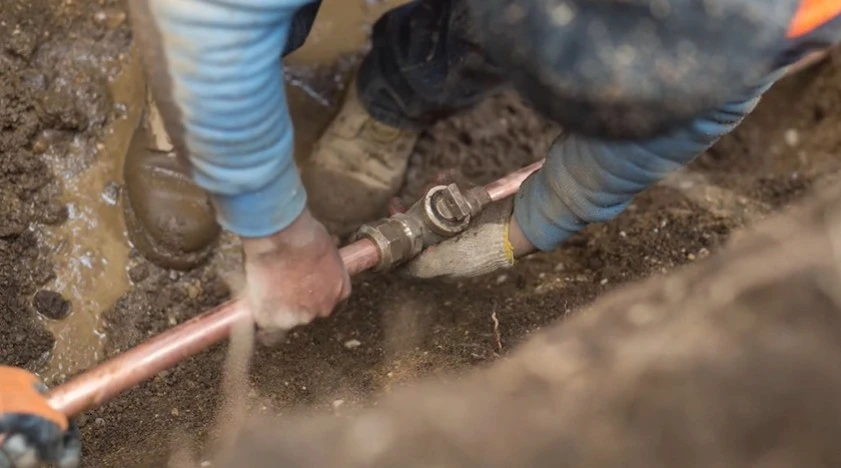
One puncture, one failed fitting, or one freeze split in an otherwise sound line. Open the ground at the failure, cut it out, join a new section, test it, and backfill.
A partial replacement fits when one run is bad.
A run under a driveway that keeps failing, or a crushed run through rocky soil, while the rest tests well, can be replaced on its own.
A full replacement fits when failures repeat.
Leaks in different sections, a galvanized line narrowed throughout, or repeated pinholes all point to full replacement, cheaper than a third, fourth, and fifth spot repair.
A reroute fits when the path is the problem.
A line under an addition, a slab that cannot be opened, or ground that erodes every monsoon season can be abandoned and replaced on a better path.
How the work is actually done
Open trench replacement.
An open trench from the meter to the house, with a new line laid, tested, and backfilled. Most direct when the line is shallow, short, or in open yard, and it disturbs the most surface.
Pipe bursting.
A new pipe is pulled through the old line path, breaking the old pipe outward, with access pits at each end. It needs a traceable, pullable path; sharp bends and unknown utilities can rule it out.
Directional boring and pulling.
A new line is drilled or pulled on a new path, often under a driveway, without a continuous trench. It also needs access pits, a confirmed path, and utility locating first.
What is not presented here as a standard drinking water fix. Internal lining is a sewer method in most guides, and it is not presented here as a standard fix for a drinking water service line.
Materials: copper, PEX, and polyethylene, without a single winner
No material wins on every lot. Choose by route, soil, water, existing material, and access, not by a brochure.
Copper.
Rigid, with the longest record, often specified as Type K for buried service work. Weaknesses: cost, rigidity, and pitting in aggressive soil or water.
PEX.
Flexible tubing that routes with fewer fittings, so fewer buried joints, and tolerates a freeze cycle better than rigid pipe. It is not freeze proof.
Polyethylene, including HDPE.
Flexible, corrosion resistant, and often heat fused with very few joints. Weakness: permeability in contaminated soil, and lifespan figures that vary widely by source.
Galvanized steel, and other old materials.
Galvanized steel, polybutylene, and brittle plastic from an earlier era are not materials to repair repeatedly. A line narrowed throughout should be discussed as a replacement.
Payson and Rim Country: what changes the job here
Payson is not Phoenix, and a Valley price does not transfer to a Rim Country lot. Payson sits around 5,000 feet, freezes every winter, and serves year-round homes, cabins, and seasonal homes that sit vacant through cold months. A cabin line needs winter preparation and accessible shutoffs.
Soil and setbacks change the price more than pipe material does. Length, depth, access, and restoration drive the labour, and a written price should show length and method.
Water source changes the job too. A town water home has a meter and a provider boundary to confirm. A well home has a well, a pressure tank, and a pump that cycles, and a leak there can look like a pump problem first.
Published price ranges
These are published national and guide ranges, not a price for your job, and not this site’s prices. No Payson plumber found in this research publishes a water line price.
| Service | Published range | Publisher |
|---|---|---|
| Spot repair, small | $600 to $1,500 | a West Valley firm |
| Partial line replacement | $1,500 to $3,000 | a West Valley firm |
| Full line replacement | $2,500 to $6,000 plus | a West Valley firm |
| Trenchless pipe bursting, per foot | $75 to $300 | a West Valley firm |
| Trenched replacement, per foot | $50 to $200 | HomeGuide, Dec 22, 2025 |
| Trenchless replacement, per foot | $70 to $250 | HomeGuide, Dec 22, 2025 |
| Full replacement, average | $2,000 to $5,000 | HomeGuide, Dec 22, 2025 |
| Main water line replacement | $646 to $2,834, average $1,702 | Angi, Oct 14, 2026, kept separate, never averaged |
| Broken or corroded pipe section, per foot | $50 to $250 | HomeGuide repair guide |
| Copper pipe repair, average | $500 to $1,500 | HomeGuide repair guide |
| Permits and inspections | $150 to $500 | Angi, Oct 14, 2026, national, not a Payson fee |
Often excluded: landscaping and driveway restoration, concrete work, permit charges, private locating beyond Arizona 811 marking, and interior pipe work past the house entry. Ask what is included in your written price.
What to tell the plumber before the visit
- Meter test result.
Did the meter move with everything off, and stop when the house shutoff was closed?
- Bill change.
When did the bill climb, and did it stay high with irrigation off?
- Wet spot location.
Where exactly is the wet or sunken ground? A photo helps more than a description.
- Pressure pattern.
Low at every fixture, or only at one? Sudden or slow?
- Water source and shutoff.
Town water, district, or well? Where are the meter and house shutoff?
If water is coming through a ceiling right now, or you cannot shut the water off, see our emergency plumber page for what to do in the first minutes.
Common questions
How do I know the leak is in the yard line, and not inside the house?
Do the meter test in the order on this page. A meter that stops when the house shutoff closes points inside; one that keeps moving points to the line between the meter and the house.
Does a moving meter prove the leak is mine, and not the town’s?
No. It proves water is flowing past the meter, not which side the leak is on. If it is on the provider side, report it to the provider.
Is trench or trenchless better for a water line?
Neither is better in every case. An open trench is most direct and disturbs the most surface. Bursting and boring disturb less surface, cost more per foot, and need a confirmed path and utility locating first.
Should I choose copper, PEX, or polyethylene for a new service line?
Choose by route, soil, water, existing material, and access. Copper has the longest record and can pinhole in aggressive soil. PEX is flexible and tolerates a freeze cycle better, but is not freeze proof.
Do I need a permit for a water line replacement in Payson?
Confirm for your address before work starts. This page gives no Payson permit fee or rule, because no current rule settling every address was verified.
How much does water line repair or replacement cost in Payson?
Use the published ranges in the table above as a guide only, never as a price for your job. The guides do not agree, and none is a Payson price, so they are kept separate and never averaged.
Water line problem in Payson, AZ? Call (928) 260-9425 and get your written price before work starts.
Call (928) 260-9425Contact
Rim Country Plumbing Co.
511 S Beeline Hwy, Payson, AZ 85541
Hours: Mon-Sun 7am-10pm · Emergency service 24/7